← Back to blogProduct Updates
March Product Update
Spring is here, and March kept us busy. Grab a coffee and see what the Readyset team has been up to. Hussle Technology Eliminates Peak-Season Database Load with Readyset Hussle Technology, a global leader in direct sales and field-sales enablement software, was facing a familiar problem: seasonal spikes in customer activity were pushing their primary MySQL database toward saturation at exactly the wrong moments, peak revenue windows. After deploying Readyset QueryPilot, those same workload
Readyset
2026-04-01 · 3 min read

Spring is here, and March kept us busy. Grab a coffee and see what the Readyset team has been up to.
Hussle Technology Eliminates Peak-Season Database Load with Readyset
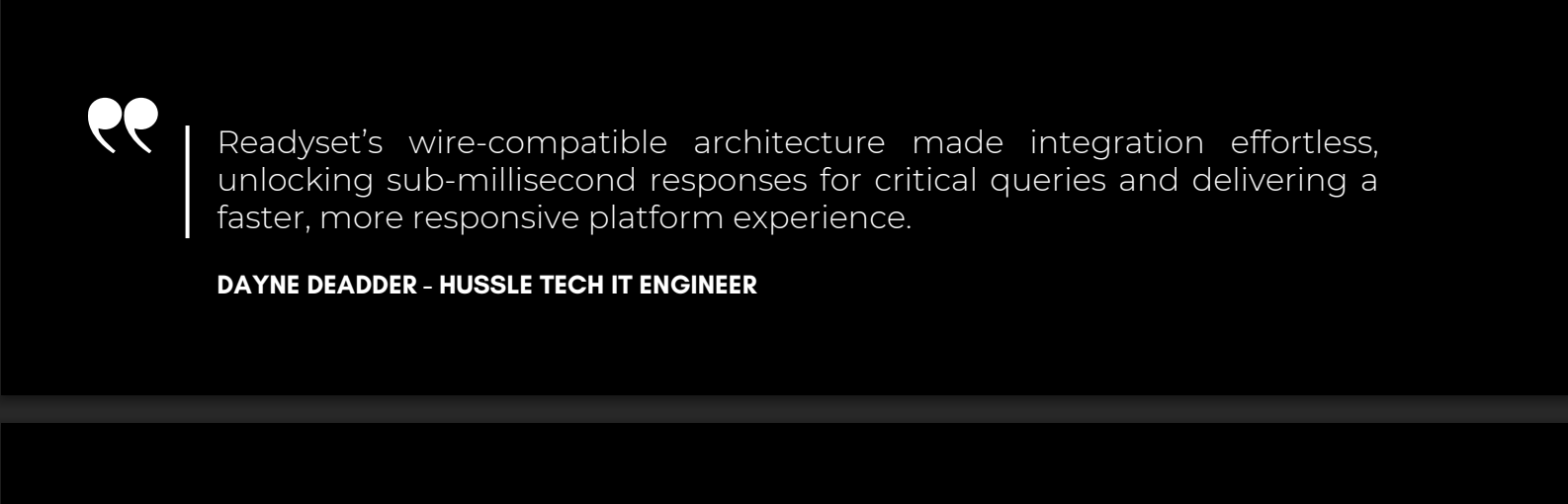
Hussle Technology, a global leader in direct sales and field-sales enablement software, was facing a familiar problem: seasonal spikes in customer activity were pushing their primary MySQL database toward saturation at exactly the wrong moments, peak revenue windows.
After deploying Readyset QueryPilot, those same workloads dropped to effectively zero active sessions on the primary. Across 11 monitored customers and nearly 1,700 queries, read-heavy traffic was almost entirely offloaded to Readyset, no application changes, no additional read replicas, no re-architecture.
Head to our blog to read the full story.
Product Updates
Readyset Core
- Shallow Caching Now On by Default: Readyset now creates shallow caches by default in response to
CREATE CACHEstatements, meaning you can start caching queries immediately, with zero ramp-up time, even without replication configured. If replication is set up, you can enable deep caching via--cache-mode deepor--cache-mode deep-then-shallow. You can also request a specific cache type using theCREATE [DEEP|SHALLOW] CACHEsyntax. - Skip Cache Hint: Added a new
SKIP CACHEhint (/*+ SKIP CACHE */) that lets you bypass Readyset caches and route specific queries directly to the upstream database, particularly useful for debugging or one-off queries that should never be cached. - New Virtual Readyset Schema via DataFusion: Added a virtual
readysetschema backed by DataFusion, exposing more system state through SQL and virtual relations. New virtual relations includereadyset.shallow_cachesandreadyset.shallow_cache_entriesto help you inspect and diagnose your shallow cache configuration directly via SQL. - Faster Array Containment Operators: Improved performance of PostgreSQL array containment operators (
@> and <@) from O(n*m) to O(n+m), significantly improving efficiency for array-heavy queries. - Smarter SHOW PROXIED QUERIES: SHOW PROXIED QUERIES now defaults to displaying proxied queries and their Readyset support status based on the current cache mode setting (default: shallow). You can also filter by cache type using
SHOW PROXIED [DEEP|SHALLOW] QUERIES, giving you a clearer picture of what is and isn't being cached in your workload. - EXPLAIN MATERIALIZATIONS Now Supports Per-Cache Filtering: You can now use
EXPLAIN MATERIALIZATIONS FOR CACHE <name>to show only the materialized nodes belonging to a specific cache's dataflow, making it easier to inspect and debug individual caches. - PostgreSQL Array Overlap Operator Support: Added support for the PostgreSQL array overlap operator (
&&), which checks whether two arrays share any common elements. This expands query support for applications that rely on array-based filtering. - And more!
Check out the full release here.
New on the Blog & YouTube
Replication Internals: Decoding the MySQL Binary Log (Parts 2–5)
Marcelo has been publishing a deep-dive series into MySQL replication internals, and in March the series reached part 5! Parts 2 through 5 walk through the Query Log Event, Format Description Event, Previous GTIDs Log Event, and GTID Log Event, covering how MySQL tracks and communicates transaction history across replicas. If you're building on or troubleshooting MySQL replication, this series is worth a read:
- Part 2: MySQL Binary Log Internals
- Part 3: Format Description Event
- Part 4: Previous GTIDs Log Event
- Part 5: GTID Log Event — The Global Transaction ID
🗓️ Upcoming Events
You Are Invited: Introducing Readyset Shallow Cache Webinar
Most production databases handle operational and analytical queries from the same system. Deep Cache was built for the mission-critical ones. Shallow Cache handles the rest.
In this live walkthrough, we'll introduce Readyset Shallow Cache, a new caching layer built to expand query coverage across your full workload with zero ramp-up time. Join us to see how Shallow Cache and Deep Cache work together to reduce database load, improve performance, and scale without added complexity.
Apr 7, 2026, 8:00am PT / 11:00 AM ET
🧑💻Request Features
Keen to use Readyset but your database or cloud environment is not supported? Reach out to support@readyset.io and let us know.
Get Involved!
Questions, bugs, ideas, or just want to say hi? You can find us on GitHub, Slack, and LinkedIn. Looking to contribute? Check out our newcomer issues, it's a great place to start.
Related articles
Continue reading more about product updates.

Product UpdatesReadyset
July Product Update
We launched the Readyset Platform this month, making database caching invisible: self-tuning freshness, eviction that can't be thrashed, and a desktop app that gets running in a few clicks. Plus a round of shallow-cache performance and observability improvements, and new writing on read replicas, TopK, and how AI is driving up your database costs.
2026-08-19·4 min read
Product Updates Readyset Team
June Product Update
June brought Web Summit Rio, the Readyset MCP server, and a round of caching performance and reliability improvements. Here's everything from last month.
Readyset Team2026-07-19·3 min read
Product UpdatesReadyset
May Product Update
May was a busy month! Between Percona Live, Web Summit Vancouver, and a packed release, there is a lot to catch up on. New Case Study: Lemit Reaches 100K QPS on MySQL Lemit, a Brazilian data enrichment and credit intelligence company, was hitting the ceiling on MySQL performance; vertical scaling, read replicas, and MEMORY tables weren't enough. After deploying Readyset, they reached over 109,000 queries per second with under 1ms cached query latency, 8x read throughput increase, and zero li
2026-06-02·3 min read
Still scaling the hard way?
Modern applications demand instant performance, even under unpredictable load. Readyset helps you eliminate slow queries, stabilize latency, and scale confidently.
Revolutionize your database performance with Readyset
Serve requests at sub-millisecond latencies with the modern database scaling and query caching system for MySQL and PostgreSQL.
Join our newsletter
Stay updated with the latest news, insights, and developments from Readyset — straight to your inbox.